One paper accepted by Neuroscience & Biobehavioral Reviews. Congratulations to Nan Wang!
Abstract
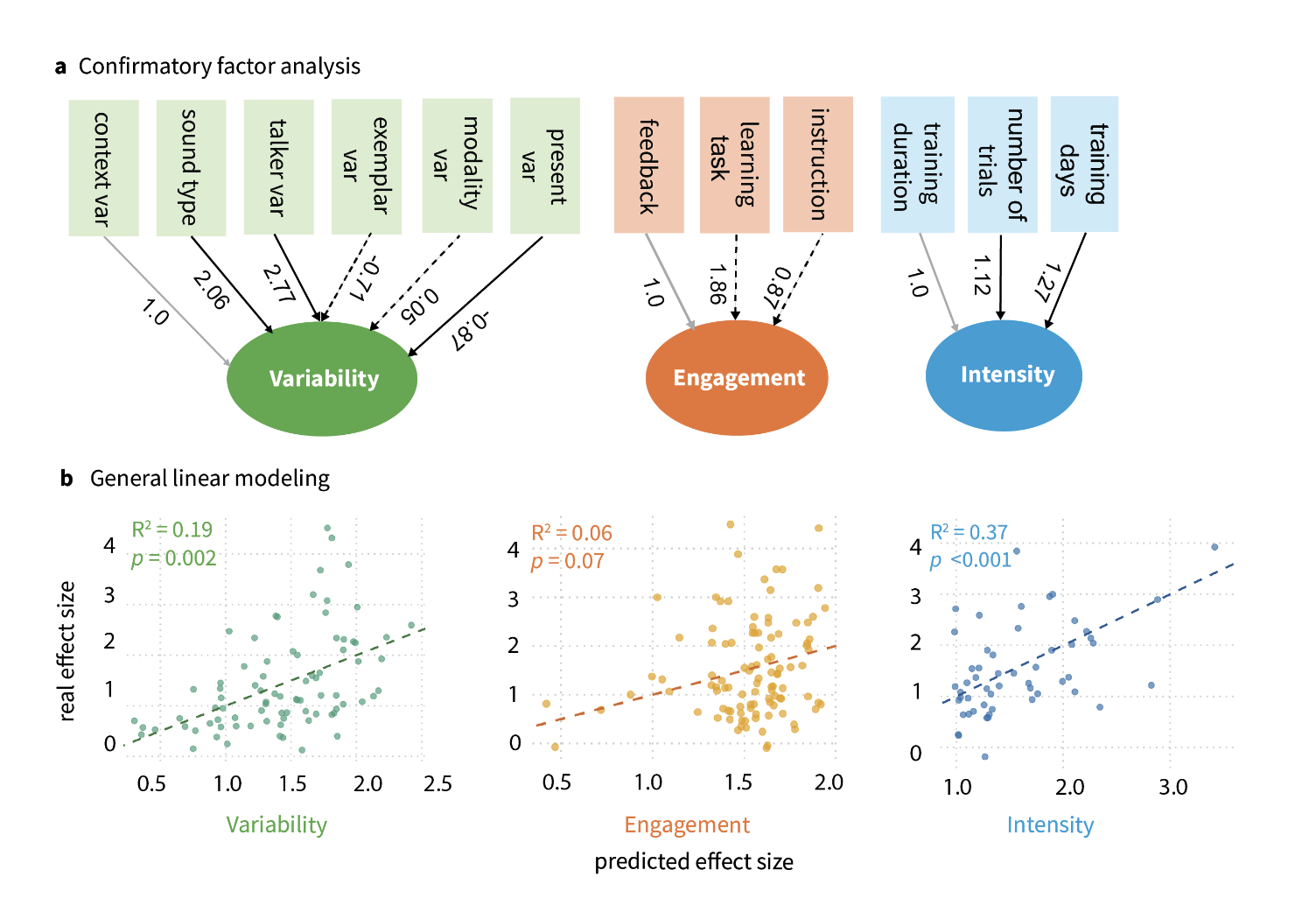
Our brains constantly reshape their understanding of the world, learning to interpret and adapt to new sensory experiences. One crucial example is how we learn to categorize sounds — a skill essential for understanding speech. But this process isn’t easy: the brain must handle highly variable and ever-changing auditory signals.To uncover what makes this kind of learning more effective, researchers at NLL Lab conducted an extensive meta-analysis of auditory category learning studies. The team reviewed 111 experiments involving 4,521 participants, analyzing how three underlying factors — variability, intensity, and engagement — influence learning success.Their findings show that training intensity and variability play the biggest roles in improving learning outcomes. A complementary neuroimaging meta-analysis revealed that successful learning is linked to increased activity in speech- and motor-related brain regions (frontotemporal areas) and decreased activity in visual processing regions (the cuneus and precuneus).Together, these results shed new light on the brain’s adaptability and offer practical insights for designing more effective training programs for speech and auditory learning.
Link: https://www.sciencedirect.com/science/article/pii/S0149763425004361